Walking east across the foothills of the Himalaya, we went up and over the Lamjura Pass (3,550 m) today. These are not the foothills we are used to in New Zealand as we were higher than Mt Taranaki and Tararua and Ruahine ranges that surround my home.
Once started we become totally absorbed with the task at hand, taking one step after the next, ensuring we stayed upright and could breathe.Wwe are quiet as we ascend, usually only Kathy and I doing any talking as even altitude finds it hard to keep some women quiet. I would try to start a conversation but talk soon dried up: there was no oxygen left for it. The men just huff and puff through the ascents, though the Doctor seems to have more words than the others at this stage.
Sometimes the big strong guys who can run all over the hills lower down don’t do as well as the scrawny old lady higher up. No sense being competitive here. We cannot do anything to alter the physiological changes in our bodies.
Young Jo wasn’t complaining about the slow place. He said that if he was at home he would have knocked anyone going this slow off the track. But this is how it has to happen. Pemba is really good at keeping a good pace and he gives us lots of rest breaks, a morning tea stop and a good lunch break. So we all arrive alive, but not necessarily kicking.
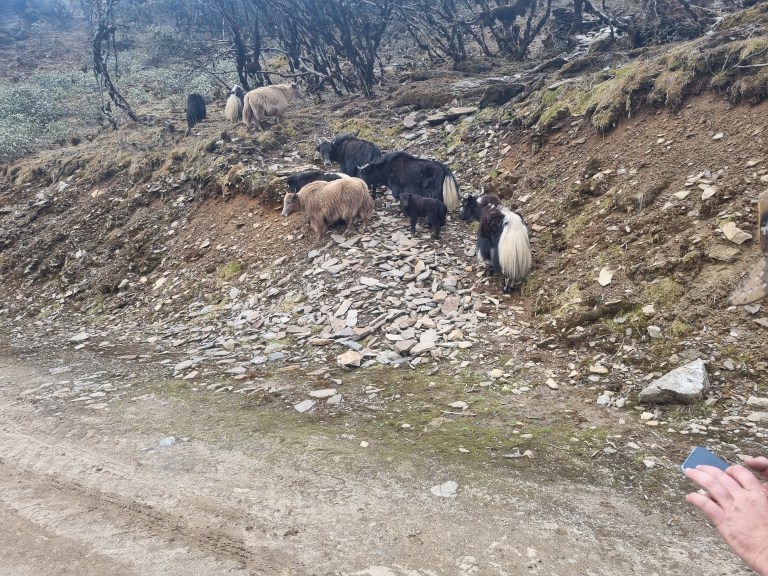
Rhododendrons. National flower of NepalAnother rest stopNew road, lots of rocks Mist coming in, getting higher and colderYaksPemba always helps with the lunchA road in the making A new bridgeJo gives out coloured pencils and school exercise booksA great wall of NepalLocal floraWe arrive at Jambesi after 9 hoursYes I am still aliveCheese and tomatoes sandwich and chips for dinner
We started out knowing we that we had about 50km to walk over 7 days, 7-8 hour days ahead of us to Lukla where I will leave the group. This does not sound much to the average hiker but the high altitude makes a huge difference.
We were to follow in the footsteps of Sir Edmond Hillary and Tenzing Norgate: the first people to summit Mt Everest. Sir Ed decided that this 7 day walk was a bit much to endure before a summit attempt so he eventually built an airport at Lukla. Therefore this trek has had little use by tourists so has remained very much as it has been for centuries. I was to enjoy it much more that the Annapurna Circuit for those reasons.
We would be walking up and down between 2,000 to 3,500 metres above sea level each day. Huge ascents and huge descents as there is no such thing as flat in this area. I have had over two weeks to get acclimatised so faired better than the rest of the crew. Roy had a cold so was feeling a bit rough and Jo was still a bit hung over from his nights on the town. So I was the only one finding the going okay. Pemba was really good and stayed in front walking at the necessary slow pace. I could see that young Joe had probably never walked this slow in his life but was probably glad for the pace.
The first day we walked to Deurali (2,700m) rained most of the day and I started out with my new lilac poncho. Purchased in Kathmandu, I found that it leaked and I was soon getting cold as we walked downhill all the way to a tea stop. At these altitudes going downhill is also a slow pace.
We stopped for a hot cup of tea at a small tea house so I pulled out my new umbrella hat which proved good for the downhill and flat parts of the trail. It reduced my vision too much going uphill. At our lunch break most of the crew bought umbrellas and then, of course, it stopped raining. I think young Jo would have trouble admitting to his hunting mates that he tramped with an umbrella!
Porters packing up their loadsGood luck scarfsWalking in the rainHot tea stopDown, down, downMy new fashion statementUmbrellas everyoneA much needed rest stop
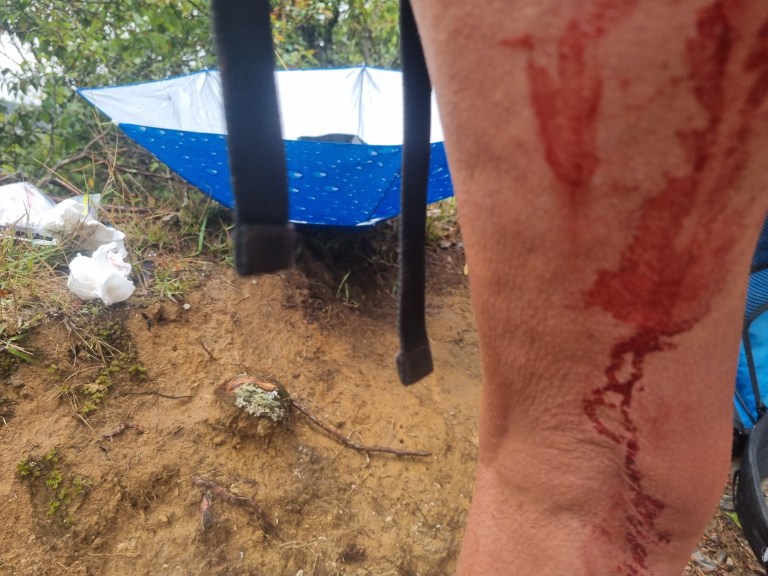
Part way through our first day I got up close and personal with Kathy. She had blood pouring from up under her shorts. The poor porters, guides and the blokes really did not know where to look when they came across Kathy and I on the track. Kathy, had her pants down and I had my head up between her legs, under her long poncho. I was trying to get my bad eyes to focus on the wound so I could work out where the blood was coming from. Kathy had assured me that, at 66 years old, she was not having her period! I couldn’t see too well at that angle but managed to put on a dressing and stem the bleeding. After we arrived that evening I was able to get a better look with my torch and found that it was a leech bite. Naughty little fella getting way up there!
This region is very steep so up and down we went. Sometimes on recently built roads, but mostly on the centuries old tracks. There was very little traffic on the roads as most people had not bought vehicles yet.
We had a nice evening around the pot belly stove and then I coughed all night, getting only about 2 hours sleep. Luckily my room mate, Kathy, snored her way through the night and was not annoyed by me. We are getting on well.
The day started with a huge decent, taking us through a very picturesque valley dotted with houses surrounded by their little farms. Most people here survive on what they grow along with their goats and cows. Then a 1100 metre ascent to Sete. Again, Pemba, went in the front and kept at a really nice steady slow pace.
Rest stopWe came up from the bottom of that valleyWe are heading up to that pass
We made good time arriving at 4.30. Kathy and I washed some clothes. The boys were more interested the teahouse owner, who had some pine trees on his property. He was using his chainsaw, no chaps, no earmuffs, no goggles and wearing jandals. They were very impressed with his final product: perfectly straight boards and all limbs intact.
Relaxing at the end of the dayBoards sawn with chainsawSherpa stew for dinner
We chilled out again at the Flying Yak hotel in the middle of Thamal. This is the backpackers area of Kathmandu although I think I saw more locals speeding around on motorbikes than I saw backpackers.
Originally I was planning to do another 21 day trek going over 5 passes greater than 5,000 metres. Five more of what I had already done!!! Why?
So after much thought , I decided to walk the first 8 days with the Kiwi group, then see how I feel. This will be a nice walk through the lowlands meandering along up and down between 2,000 metres and 4,000 metres of altitude.
I will leave them in Lukla where they can continue onto the higher alttides without me. Unless I change my mind, which I seem to feel free to do at any time, these days.
Kay goes home tomorrow and I will move to the hotel the Kiwis are staying at.
The shops sell treking gear that is knockoffs of all the famous brands. North Face, Kathmandu, Marmot, Leki, Osprey, Salomon, Mountain Hardware etc. . You can buy jackets, sleeping bags, packs, headlamps, cookers, fleece tops, shirts, shorts, all sorts of ski and mountaineering gear. The gear is usually made in the same factories as the stuff we get back at home. However, all the fancy marketing, transportation, and profit structure are missing. Therefore the prices are only about 10% – 20% of what we pay at home. There are hundreds of these little shops and I wonder how they make a living.
Bargain pricesBartering expected Pashmina shawls More shawls Jewelry shops galore (Not my thing at all)Elephants and Christmas decorationsBlingy bags Rugs and bags
I do wonder how any of these shop owners can make a living. There are hundreds of shops selling the same stuff and there is seldom anyone in the shops. Bargaining is the way to go.
We got a bit lost and found the food stalls
This made me pleased that I am going vegetarian on this trip
We paid for a full day tour of some of the UNESCO Heritage sites.
Our guide and driver were good but most of what we saw and heard was religious history. Fantasy stories about the 30,000 different Hindu gods, Buddhas from different countries, one born from the armpits of his mother. About as likely as the Virgin Mary, I suppose.
They are not stories about the real people of Nepal, It seems that the people and their religions can not be separated.
I must say that the reconstruction after the major earthquakes in 2015 has been done amazingly quickly. Christchurch took about 10 years to decide whether to reconstruct the cathedral, while Nepal just seemed to get on with it.
Amazing buildings
Anyway, I have seen my full of temples once again.
We stayed in our nice hotel for 4 days, hiding out from the sun and people, while our sunburned faces healed. After a full breakfast at the hotel we would cover up and go out for a bit of a walk around before the sun got too strong and the young ones emerged. Then we retreated to our room to catch up on media and reading or watching some sky movies on the big TV.
Elegant Hotel
Our coughs had cleared up as we descended from the mountains, and we weren’t sore, other than our faces. Our bodies are used to long walks and steep climbs, so we fared better than many others. I am sure my legs just think ” Here she goes again ” and get on with it.
Haircut and massage
In New Zealand, I pay $32 NZD at the cheapest chain of hairdressers. Here, for $30, I had a haircut, a scalp, head, neck shoulders, and back massage. I really needed that after the bumpy bus trip as my poor head had bopped and bumped around for hours. When he had finished, my neck felt better than it had for many months, and my sinuses were clear.
Peeling faceFinal dinner with Basu and RamPokhara Lake
Pokhara is the Queenstown or Taupo of Nepal. Being a land locked country, the huge lake is a real attraction for Nepalese. The rich have holiday homes here, and it is a quick flight from India. There are a lot of different treks around the area so most overseas visitors come here too.
Potholes everywhere Evening view of the lake
One day, we walked for about an hour across the city to the National Mountaineering Museum. It was very interesting and well set out, taking about 2.5 hours to look around. Well worth the visit.
Backyard gardenRubbish collected from Everest Base Camp
Again, I was quite disappointed with the rubbish situation. The lake had garbage floating in it, and drains were full of plastic rubbish. The man at the hotel told us that there were some collections from the businesses, but he doubted if it was disposed of properly.
Such a shameEvening on the lakeside
After three days we were both feeling better so we took a 25 minute Buddha Airlines flight back to Kathmandu. Their safety record isn’t the best, but we decided we had pushed our luck on the buses. The flight was uneventful with no real views of the mountains because of the smog.
With very sore faces, we were on the bus at 7 am. Basu ushered us into the front seats, but this caused a bit of an argument. Eventually, we were sent back to the rear of the bus. Bless Basu, I think he was trying to play the poor, sore, old ladies’ card for us.
Here is a link to my video of the bus trip. I am not a filmmaker, so the filming is not very good, nor is the commentary. I have made it not suitable for children as my language is a bit colorful. (You may have already seen this on my Facebook page)
To be fair to the roads in Nepal, there are a lot of challenges they face. The country is mostly mountains with 8 of the highest peaks in the world. Working at high altitudes is hard. Just walking us hard let alone actually doing anything more physical. Helicopters can’t be used because of the thin air.
The monsoon rains and snow melt create massive water flows, which wash away the work that has been done.
Nepal is extremely poor, so China and India are doing most of the road construction. The trade routes are important to them. Still more than 30% of Nepalese live more than 3 hours walk from any road. When I washete last time most goods moved by donkey or porter on narrow walking trails.
Before we went to sleep we agreed to wake the other one if we thought we were dying.
We both woke through the night coughing like a couple of dying sheep. I wondered if the altitude had finally gotten to me but did not have the energy nor inclination to do much about it.
Altitude illness is divided into 3 syndromes:
acute mountain sickness (AMS), (like having a bad hangover)
high-altitude cerebral edema (HACE) (the brain swells, so you begin to act drunk – confused, unsteady, and stupid)
high-altitude pulmonary edema (HAPE). (Lungs fill with fluid, and you sound like a dying 90 year old. Breathless on excersion, a cough and weakness.)
They usually come into play a few hours after the high altitude is reached, i.e. during the night and should be treated with a quick decent.
We both made it through to the morning alive , but Kay nearly had a heart attack when she looked in the mirror.
Her face was red and swollen, her eyes could hardly open, and her lips looked like botox gone wrong. And I wasn’t much better. I looked like a Panda Bear on steroids. (Kay wouldn’t let me post her photo, understandably)
Ouchies
We should have used sunscreen regularly throughout the day as we saw the young ones doing. But we didn’t have the energy to do so, and now, we are paying for it. Two days later, we are still blistered, sore, and peeling.
Basu came in to take our breakfast order and took one look at us and decided we would take the bus today instead of walking to Jomson. We did not argue with him.
The main attraction in Mukintath is a Hindu Temple high on a hill at the edge of town. There were a lot of pilgrims heading towards it as we walked to get our 8am bus. Some walking, many on the back of small horses, the sick and elderly being carried on stretchers.
Taking the easier way upSick person
We walked to the bus depot with Kay hardly able to see out of her burnt eyes. I won’t be complaining about the pot holes around my home after navigating the main streets of Nepali towns.
Walking to bus depotBack seat filled with backpacks
The bus trip to Jomsom was only an hour or so of terror.
I have since read that one of the causes of excessive wear and tear on roads and bridges is the overloading of vehicles. Every bus we went on was filled to the brim with more people than seats, bags and boxes up the isles and roofs overflowing with stuff. However, I have not yet had to share a bus with a goat, pig, or cages of chickens as I did on my previous trip through Asia.
Soldiers on the street Jomsom airport
Arriving at Jomsom, we were treated to another nice room that backed onto the airport. The flights come in very quickly in the mornings while the air is clear. This is one of the shortest runways in the world, and the planes can’t fly over the mountains because of the altitude, so swoop between them. We decided it was safer to take the bus to Pokhara the next day.
Main street of JomsomPlane watching
We were both feeling a bit miserable, still coughing, and our faces were getting worse by the hour. We were cold and shivering, so we climbed into bed to rest under orders from Basu.
A beer before dinner
We had dinner with two trekkers who had gone over the pass the same day as us. One from Jordan and the other Canadian.
I didn’t sleep all night as my mind was racing through many things, so I was up before our 3.20 am alarm.
Outside our room 3am
Looking outside, I could see that it had not snowed overnight and the sky was clear. There was a lot of action going on at the hotel down below, so we presumed the day would go ahead as planned. We put on all our layers and opened our chocolate bars, knowing we would not be able to do this with double gloves on.
Toilet frozen over
With our microspikes on over our boots, we somberly ate breakfast. Kay looked very frightened, and I tried to put on a brave face although my stomach was churning. Nerves and too much dal bhart meant I had already had three trips to the outside squat and knew there was no way I would be able to manage undressing with all the gear and gloves, let alone have the energy with the lack of oxygen. So I took 2 Diastops to bung me up. (It worked)
4amMicrospikes fit over boots.
We left at about 4.30 am. with our head torches on, following a trail of trekkers slowly up the switch back track. I am not sure how the first party worked out where to go, but I didn’t see any sign of bodies having slid off the track. All good, keep going, Karen.
Long line behind us
I was really puffing, and each step took a lot of energy. I wondered how I could keep it up for another 6 -8 hours. Looking down behind us, there was a steady line of torch lights crawling up the track. I am not the only mad one!
Kay (69) and I (64) are by far the eldest of the trekkers. We are always getting asked how old we are, and they all say we are such an inspiration to them. They come to us for advice on what to wear, eat, and for some motherly comfort and encouragement.
Around the fire the night before
We took 1.5 hours of steep climbing to get to High Camp. The last 100 metres was hell. 8 steps then stop and try and get my breath, then another 8 steps.
High Camp. -15°
We went into the cave like shelter for hot tea, and Kay used the toilet, arriving back with severe pain in her hands, having taken off her gloves. She was terrified, but Basu warmed her hands on her tea cup, and she eventually relaxed.
Poor Kay.
A young guy came in wearing a pair of Chucks boots and in awful pain. He was worried he would lose his feet to frost bite. What was he thinking? It was -15°! He asked me if I thought he could run over the pass to Mukintath in the 2 hours that he thought he had left before frost bite set in. Again, what was he thinking? I said definitely not, so off he went back down. With all the internet information around, there should be no reason to come up here so unprepared.
Ram, our Porter, was not wearing gloves when we started out. His reason was that he needed to have full use of his hands so he could help us: grab us if we fell and help with our gear. He was mountain born, and his hands seemed to function well in the freezing temperatures.
Ram was my personal dresser for the day. I felt like I was a model. Hat on, hat off, jacket zip down, not that far, jacket zip up, gloves tighter, gloves looser, sleeves over gloves, pack straps undone, pack straps done up, water bottle out and lid opened, glasses taken off and cleaned and put back on, chocolate out, unzip front bag to get camera out, take photo (no turn it around!) Poor Ram, he was my hands for the day and I was very pleased to be paying him about $20 for the day. I really didn’t care that he had bare hands at this stage.
After the High Camp, the track wasn’t so steep, but it was relentless. The increase in altitude that day was nearly 1,000 metres, up to 5,416 metres.
Don’t slip as it is a long way down
There were dozens of false summits. Just keep going to that flat bit, Karen. But when I get there, it is not flat at all. The track just winds up again and again.
No, that is not the top
We were both pleased to have our microspikes as these meant we did not slip at all.
Do we look like we are having fun?
We were being overtaken by groups, but they all looked as bad as us and gave us Grannies lots of encouragement. Everyone was in awe of us old ladies.
Aussie family trying to look good
Horses can be hired at a number of places on the climb, and I was seriously contemplating getting on one except the last horse had been taken by a young Israeli girl. I had had a few conversations with her over the previous days, encouraging her to keep going as she was finding it hard going. She gave me a big wave and smile as she went past me. So the only thing I could do was keep on plodding.
She took my horse!
Never the less I am very happy to say I made it under my own very slow steam to the top.
About 50 metres from the Summitt, I came across a young woman, kneeling in the snow, in tears. Glad for the excuse to stop, I knelt down and gave her a big cuddle and some words of encouragement. I was crying with her.
Really, I was doing it for me because that was just what I needed. I was damn near spent. Eventually, we both got to our feet and made it to the top.
We spent about half an hour there before being ushered on by Basu. The weather changes at about 2 pm, so he wanted us down off the mountain by then.
So down we went. Firstly through snow, then ice, then slush and gravel. The microspikes saved the day as I saw Basu slip many times without them. Kay was much more confident than the previous day and required Ram’s assistance rarely.
Kay and Ram coming down behind me
Even though we were going down, we were still at high altitude, and our lungs were struggling to give us enough oxygen. Our oxygen saturation on the summit would have been about 70%. If I was at home, I would have been in intensive care unit.
Regular medical stations on the way down.Time for a restSnow, ice, sludge, and rocks.
At about 2pm and 8 hours after we began, we were sitting in a little tea house ordering our lunch, with it snowing lightly outside. We really didn’t have much of an appetite, but we knew we needed to eat as we still had another hour and a half to go. Soup seemed the best idea.
Let’s just have noodle soup.Outside the snow was beginning to fall again
We carried on to Mukintath where Basu had booked us another lovely room with inside bathroom but 2 floors up. Gosh, we moaned about those 2 flights of stairs!!!
Basu says, “Shower and get into bed, and I will bring you your dinner.” That is all we had the energy to do. We were being looked after so well.
Even though it was a hard day, it was also beautiful and a real achievement. Not many people are able to walk over a remote mountain pass like we did. I am sure that in a few days time the memory of the hardship will be gone and I will be see it as an awesome day.
I am grateful that my sense of adventure is still alive and that I am too.
510 metres of ascent over 12km. Slowly, slowly in snow all day.
It started to snow lightly and continued all of the 4 hours we were out on the track today.
At first, it was lovely, but we needed to stop and get our rain coats and over gloves on as it didn’t look like it was going to let up. It really was a beautiful sight to see the bushes and hills being covered in snow.
Each time stopped we cleared the snow off eachother.
We stopped at a cave-like tea house to put on more clothes
Kay was quite out of her comfort zone as the track got narrower and steeper. I was feeling quite confident although I was very cautious. The boys looked after Kay well, although I am sure she was cursing me for bringing her here.
We had to go down a steep part that was icy and slippery, which meant we were not daring to look more than a metre ahead. When it flattened out, we were horrifiednly to see a snow-covered swing bridge that we needed to cross. Ram went first and kicked away snow, I was next and did the same. I actually felt okay about it. Kay was coming behind with Basu close by her. She was terrified, but she is a strong old duck and had no choice but to carry on over. The look on her face in this photo shows it all.
Why am I here?
The day went from bad to worse. Steep drop offs and narrow slippery paths took a lot of concentration but I was feeling good, if not puffed. Kay was way put of her comfort zone.
At one point I slipped, landing very heavily on my bum. It hurt, and I was surprised that I didn’t get a bit more protection from the good amount of fat I carry in that area.
I stayed on my bum for about 20 metres, sliding along listening to the boys, helping Kay slide along behind me. Everyone else got down and followed suit.
We couldn’t afford to muck around as we were in an avalanche area. The altitude made it hard to go fast, but eventually, we were at the Tea house at Thorong Pedi. Some people were going another 60 -90 minutes up to High Camp, but we had always planned to stay here.
Hugs, high 5’s, warm clothes and lunch around the fire, a Nana nap, and we were all feeling better.
Yak dung fires make us happy
The big question is what we will do tomorrow. Go ahead, as the snow is supposed to stop or stay a day. I think most of us just want yo call a helicopter to get us out of here.
After dinner Kay and I put on our microspikes and had a wander around. They really take away the slip and slide and made us feel better about tomorrow. We went down the hill a bit to another hotel where we caught up with some other trekking friends, including the Aussie family. Everyone was pleased to see us and their guides have similar plan to ours. They will see what it looks at 3am with a 4 am. start if there has been no more snowfall overnight.. They have some experienced parties to send out first to make a path for us to follow.
7.30 pm and I will now read a bit then get some sleep. I hope this is not my last blog
We went to bed listening to thunder and the rain on the roof but woke to see it had snowed overnight down to where the old monk lady lives. I hope she had her winter nighty on.
After our breakfast of porridge and apple and a coffee we were ready to leave by 7.15. I managed to resist the pastries on shop next door to our hotel.
We did have some the day before
We walked slowly up hill and soon came across a site I don’t think I will ever see again. There was 2 very thick wire ropes snaking up the hill for about 300 metres. About every three metres there was a young man tying a piece of wood across the two wires and wrapping it in pieces of rag.
Basu asks the questions for us, and we find out that it is for a new swing bridge that will be constructed up by the Pass. They will carry it for 24km with an increase in altitude of about 1,000 metres.
I tried to pick up the thick wire rope and really struggled to do so. I really cannot fathom how they can coordinate 80 people to carry such a weight on a narrow track a steep hill at over 4, 000 metres above sea level. We are struggling to carry our jacket and water for the day!
Strong, desperate young men
The thought of what those poor young men will go through really upset me. It reminded me of the slave days or how people were treated on concentration camps. Basu assured me that they would be well paid for their work.
Make your own comfort
The Aussie family who were behind us took this photo of them on the move.
Slave labor?
We had a lovely slow walk up 510 metres over 9 km, with a few flat and easy decents. At last, we had seen the end of the road, and the true Annapurna Trail emerged.
Some lads on horses played leap frog with us all day as they rested their loaded up horses regularly.
The sound of many bells alerted us to a huge herd of yaks that were coming down off the mountain and crossing the track. Kay and I waited until there was a decent gap before we sneaked through to catch up with Basu and Ram. The yaks were off the be milked for making the local delicacy of Yak Cheese. We haven’t tried any yet as Basu says the cheese is hard to digest if you are not used to it. We are best to wait until we get over the pass.
It was cold when we arrived with snow patches around our hotel. We were lucky to get a room with an inside bathroom, However it was a squat job that backed on to another squat toilet. This meant we could hear the person grunting and grading through the single plank wooden walls. It was the first smelly toilet we had encso couldn’t really complain. What do you expect for $12.
We had a lunch of noodle soup to warm up then climbed into our beds with all our warm dry clothes on. Read a bit, then both fell into very deep sleeps. Basu comes at 4.30pm with the menus so we can order dinner. We really do get waited on hand and foot by our boys. They can’t do enough for the 2 Madames.
A Nana nap before dinnerHotel, very pink.
We get up half an hour before dinner and prepare our gear for tomorrow as it will be dark and cold when we get back from dinner.
Dinner time is a social time with the other trekkers as we sit at tables around the big pot belly stove, which is fueled with Yak dung. This is collected through the summer and dried on the sides of the houses. It doesn’t smell
The Aussie family with 2 girls are friendly and tonight we talk with a woman from Jordan. She is a bit concerned because her guide is not giving her any advice or care like ours is.
Basu has been taking our oxygen levels 3 times a day since Manang. Kay and I are both sitting at about 85 which is good for this altitude. Neither of us have headaches, so far so good.
There is 2 ways to get to Manang. One that goes up really high and takes about 7 hours or a lower way mostly along the road. Kay and I decided we did not need to put our old bodies through any more climbing than necessary so we took the low road.
This was definitely the right decision as Kay had a hard day of it. I had had my hard time on the first day and was feeling really good today as a lot of the road was flatish.
We met a couple of women who recognized more people and buildings in my photos
Looking at my old photos
However, when I needed to run up a hill looking for an emergency toilet, I really felt the full effects of the altitude. I wasn’t sure whether I would die from embarrassment from shitting my pants or having a heart attack. Luckily, a little old lady let me use her toilet so a disaster was avoided.
It was another basic squat job with a bucket of water for cleansing the bum. So my quads are getting a work out. My aim is getting better.
I walked a bit with a woman from Brusselton, Western Australia, who was here on her 6th visit to Nepal with hubby and 2 small girls, 12 and 14 years old. She walked, but the others took a jeep because the kids both had snotty noses. They are heading to the Thorong La Pass the same as us.
Piles of firewood was stacked up along all the fences and we saw an old fella ploughing his little field. Basu said most people have rotary hoes now.
Ploughing a small fieldLocal transport is horses now. 17 years ago, it was donkeys
We also saw a group of very dusty young people breaking rocks by hand. Last time I was here there was hundreds of young, single women with their babies on their backs doing this work. This was all they could get as single mothers: living under tarpaulins with their kids. So things have changed as we have walked through a number of large queries with mechanical machinery doing the work. Never the less I wonder where the single mums are nowadays.
Not everything has changed though. I came across the little old man who I am am quite sure I bought a hat from 17 years ago. He continues to live in a very basic abode selling beads and artifacts to us trekkers.
His house
The hat I bought in 2006 made it back to New Zealand despite being fox fur. She has been my stand-in pet and is named Annapurna, of course. Anyone who has been to my house will have met her and given her a pat.
Annapurna and I in 2006
We arrived at about noon and had, yet again, to bear the indignity of looking horrified at having to climb 2 flights of stairs to our room. Basu keeps getting us the best rooms with the nicest views. We shouldn’t complain!