Day 7. 19 March Rest Day in Menang

Now it is important that you understand that a rest day, whilst on a damn long walk,  is not like a Sunday sprawled on the couch, with a bag of chippies, a beer, and Netflix.

First thing to do is hike about 350 metres  up a hill at absolute snails pace, one slow step after the other. This is necessary to assist with acclimatization. We need to have been higher during  than we are to sleep at night.

This arduous walk was well worth it for the views of the mountains and the valley below. We stopped at a stupor, which is built to honor the dead and for a break at a wee tea house. We didn’t buy anything as we had bottles of electrolyte solution that we had to drink. We need to have a litre of that a day and another 3 litres of fluid. Obviously, I did need to use his toilet.

Slowly, slowly.
75 year old monk woman

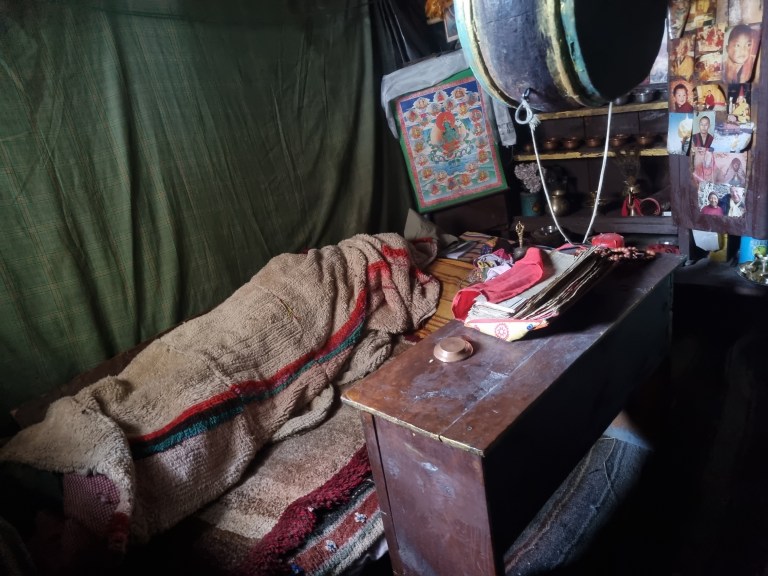
The hard walk was well worth it as at the top was a one woman monastery. We were shown around her home, which was built in a cave  on a steep cliff. Then we were invited in for a  ceremony and received a blessing to give us luck going over the pass. A necklace was put around our neck, and then she asked for 100 rupee donation. So another scramble through the money bag in the dark. I hope her blessing works.

She is  75 year old female monk, and we were told that she was completely snowed in for 21 days straight last winter. But it wasn’t so bad this year as she had a solar powered battery and a light bulb. Tough lady.

Buddha blessing
Basu receiving  his blessing
Sleeping area
Kitchen
Nivea cream has reached a monastery high on a hill in Nepal

After that wee jaunt we have jobs to do. Clothes are washed.

  • The first cycle is stomping on them on the floor while having a just-warm shower
  • The second cycle is a rinse in the bucket that provides clean water to wash your bum with.
  • Then wring out as much water as you can by hand
  • Find a line in the sun with a breeze and hang up with the 5 pegs I have brought from home. Sometimes lucky enough to supplement with pegs provided.

Other jobs  include tipping everything out of my pack to find the one item I have lost.  Kay and I both seem to lose something that we have put in a safe place on a regular basis.

Updating our social media, attending to feet, reading and chatting with other trekkers, and shopping takes up time, too.  We bought chocolate, sweets and biscuits for the Pass day as we will be about 10 hours before a tea house.

A large family group was staying here. One was a Nepalese man who lived in the next village until he was 9 years old. He then moved to Switzerland. He had brought back about 12 members of his family to see his birth place. Having arrived by Jeep, they were celebrating with bottles of the local whiskey. They were a fun lot.

Family group
Kids on the streets. There is no shortage of stones here.
Vultures in the museum. They halp out with the sky burials
Tempting French pastries
Local 4 Square

Day 5. 17 April To Pasang

To Pasang nice day some track some road. We walk very slow on the uphill sections, but I find I speed up naturally on the downhills.

Before we left we found The teahouse I stayed in last time and showed the owner my photos. She recognized people and dragged us up 2 steep flights of stairs to show me the additions they had recently built. The family and staff now lived in the rooms I used last time. She recognized people in the photos, but again I am told that the mothers were dead and their children have moved away.

Looking at old photos

The steep climb up the stairs first thing in the morning Sent my heart into a real spin. So a few metres along yhe street I was puffing into my syringe and throwing my legs up into the air. This gave my guide and porter a bit of a fright, but the method works to bring my heart rhythm back to normal. We were by a sign that pointed to the Medical Centre so it was close to help if needed. No need for a helicopter ride to hospital this time.

We follow the river through gorges with views of mountains all the way.

Narrow gorge road

This is a forestry area and we see signs of logging some kind of pine trees. There was a large established apple orchard with a quite modern processing plant. This provides employment for locals and a good profit for the owners I expect. We stopped for a coffee and apple donut at the very modern shop and I popped into their Farmstay Lodge to use their toilet. (10 stars)

Farmstay Lodge, definitely for the wealthy.

Jeeps going past full of trekkers who don’t want to walk. They come up and have a look around and go back down again with bad backs and blisters on their bums from the bumpy ride.

Prayer wheels at the entrances to each village, so we pray for a safe crossing

The air is cooler but the sun is hot and the pollution haze has nearly disappeared. Each jeep and motorbike that passes us puffs out clouds of black smoke and stirs up the dust, so I presume we will only be clear of the pollution when we get above Manang, where there is no road. We have joined the locals with the sniffing and throat clearing as our body tried to rid us of it all. People die early from lung disease here.

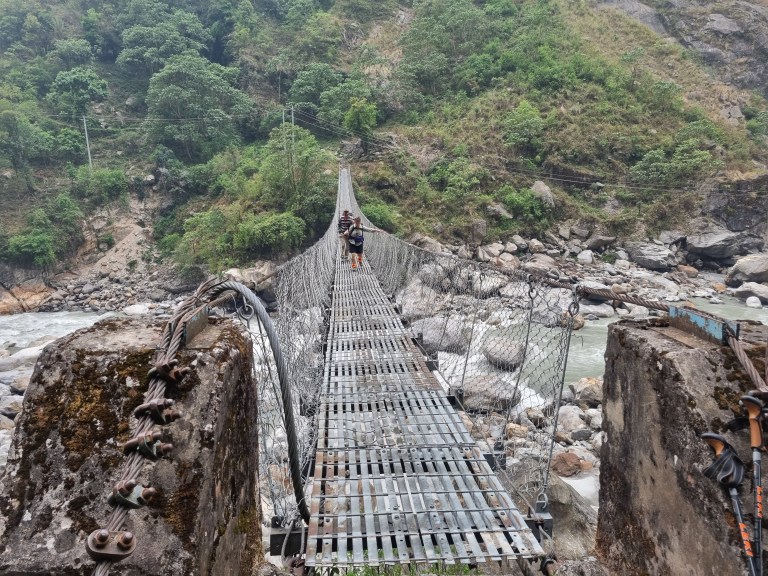
Jay carefully crossing a swing bridge
A nice break in the shade.
Road dusty but mountain glorious
Lunch time and over 3 000 metres above sea level
Kitchen at our lunch stop. The food is very good.
View of snow capped mountains from lunch stop
Our hotel. Very brightly painted. 3rd floor room with a view
Our home for the night

Days 4 16 April

7 hours walk today, which included an hour and a half for lunch. We had an elevation gain of 610 metres, taking us to 2,710 metres.  Mt Taranaki is 2,518.

A picture tells the story

A little rest on a hot day

We saw our first New Zealand sponsored water station. 40 rupees (50 cents) for a litre of fresh water. These are given to a local women’s co-op to make money and serve us trekkers.

As we entered one village we could hear the music and chanting from a  Buddhist temple that had a festival day.  Basu asked if we could come in and they welcomed us. We went upstairs to their payer room and Basu said we could take photos as long as we left  a donation at the altar. I kind of made a fool of myself trying to find some small notes to leave. It was dark, and I had my sunglasses on, and I am quite blind at the best of times. The first notes were far too big, and I fumbled around in my plastic bag of notes until I found something suitable. I was quite embarrassed and felt uncharitable  with the monks all watching me.  But the ladies outside gave us a cup of warm, sweet, milky tea which we enjoyed sitting in the sun.

The road is constantly  under repair  a Nepal has earthquakes and a rainy season the causes landslides and avalanches.  Three years ago this valley lost many houses, parts of the road and lives. So there is a lot of construction and building going on.

Broken bridge and new bridge
Piles of shingle

Other trekkers walking the same as us include a young Aussie couple, young Frenchman who sits outside with a beer and smokes on arrival, Lydia who is a German woman who has just finished her medical degree. So we leap frog with them all day.

High narrow roads

We were very pleased to be walking on the old track for most of the time  rather than the new road. If you have ever seen that TV series of the world’s worst roads, you will have probably seen this one.

The road goes around that peak

Today was about 25 ° but we were in and out of the bush most of the day which gave us some shade. We spent half of the day on the old track.

Lunch break at 10.30 for 1.5 hours. We cool our feet under the tap alongside the lady who is washing the greens for lunch.

Lunch rest

The further we get along the trail the more friendly the people are. We are now seeing families working in the fields planting crops. They grow barley to use for flour in bread making and porridge, corn is also made into flour and eaten fresh. There were apple trees beginning to blossom and some areas of new planting to stop erosion. Looking up above, I am not sure how safe they will be from the next landslide.

Linesman at work
He climbed up there using a knotted rope

The linesman had not finished their job as we had no electricity at our home for the night. We are in bed before dark anyway, being a couple of old grannies. But we are first up and leaving before the young ones wake up.

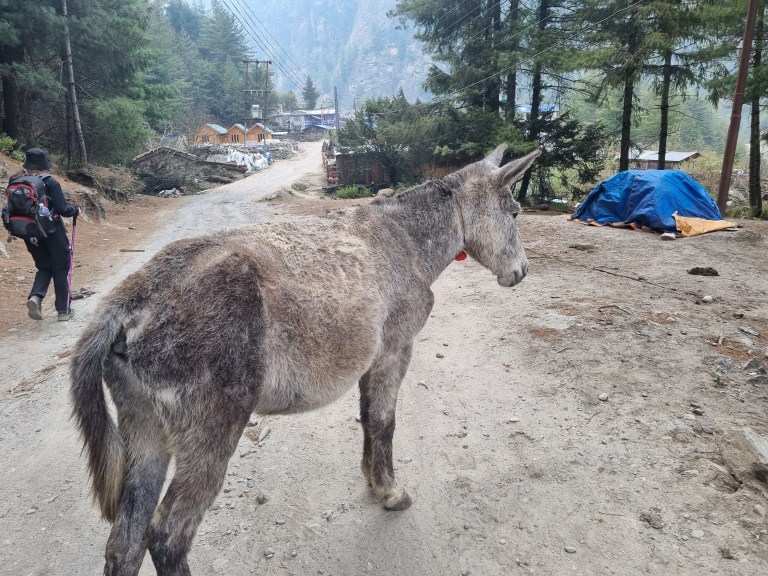
We came across a few donkeys wandering aimlessly around, and I wondered what happened to the hundreds that had been working the trails when I was here last time. Since the road was constructed, they have lost their jobs.  I hope they got a good redundancy package and a nice field to retire in

Sad looking donkey wandering on the road

Feeling happy.

Day 3 15 April to Charmje. 8.5 hours.

Again we walked the first half of the day on the old trail. Having a total elevation gain of about 250 metres meant we were heading higher. The trail had some ups and downs but nothing too bad.

Basu goes up a wee hill on the old track.

Slowly, slowly, our Guide, Basu, tells us. As if I could go fast in this elevation. We are at about 2,00 metres above sea level, so we are already lacking oxygen.  Looking back at my diary, I saw that I was struggling to go slow last time I was here. Puru had to walk in front of me to slow me down. But 17 years later, my guide waits at the top of the hill for me.

Basu and Ram waiting for us
Old track
New road is constant road works
Nice metal swing bridge

Lunch at a really cute we teahouse. It had ony one room where they slept cooked and ate and served meals. Dal Bhat was the only thing on menu and it takes about 30 mins to cook and smells delicious. We take off our shoes and lay down to rest. So I am ready to eat when it arrives.

Lunch stop
Kay is looking hungry
Small child asleep beside us

Our guide and porter serve us. They stand and wait until we have had a few mouthfuls and give our approval before they disappear to eat their lunch.

Huffing and puffing up another hill
Apple trees
Not a very fancy bridge
Lady grinding up garlic at a teashop
We walked to Charmje today
A room with a view

We keep getting rooms on the 3rd floor. They may have a view, but we think we have walked up enough steps

We showed the owners my photos from 17 years ago only to find that the adults had died and the kids had all left the village.

Day 2  14 May. Bahundanda to Charmje

This was an 8.5 hour day, 12km in  about 30° heat,  uphill most of the way on the old Annapurna Track.  We probably did 79% on the old trail today.

I was saddened to see the changes, no trains of donkeys, and very few locals out doing their thing. Buses, jeeps and motorbikes shared the road with us. But the views were good, and I loved being back out on trail.

As we walked along the right-hand side of the river, we could see the road weaving its way along the other bank. We were very pleased to be on our side away from the dust and constant uphill gradient.

After lunch I was on the lookout for toilets as my body was getting used to the local cuisine. We refill our water bottles at the Tea Houses and pop in a water purifying tablet.  We are trying to remember to sanitize our hands before eating but are not always so good at this.

Tea Houses are all along the trail and the road ready to sell a coca cola, sprite or a cup of tea and meals. Some provide accommodation too.

On the road we came across some hardy chaps from Belgium riding Royal Enfield motor bikes. They had been on a couple of trips around Nrw Zeakand by bicycle and campervan and were very proud to hear that they ratedNew Zealand very highly. The young french man at our tea house was also telling everyone that New Zealand was amazing.  We were very proud Kiwis.

There has been a lot of work completed around the wee villages by Chinese. There are power stations and miles of power lines going up extremely steep hills. This is giving power to the villages that had none when I was here last.   I wonder if China is getting the roads snd infrastructure in place so that it will be easy to get their tanks and soldiers here for an invasion.

We stopped at the FishTail guest house for a much needed rest and  lunch. Everything is cooked from scratch, so we have about an hour to air out our feet and rest our bodies in the shade.

I struggled for the second part of the day in the heat and was very pleased to arrive in Charmje at 4pm.

Over dinner I shared my photos from the area 17 years ago and with the owners of the guest house. They were very excited to recognize their daughter as a toddler.  She came out to have a look. Back then the children were all very excited to see themselves on our cameras but now they have grown up and have their own. The kids all gave their faces in cellphones and having tantrums if they are taken off them. Such a shame.

It was a 4 wheel drive, now it is a 2 wheel drive.

A Dam Long Bus Ride – 13 April 2023

We started our day at 6.15am with a taxi ride with our guide, Basu, to the city bus station. There we met Ram who is to be our porter for the trek.

Kay and I are quite capable of carrying our own gear, but we wanted to make sure we contributed to the economy.  So we will pack a duffle bag each with the stuff we don’t need through the day and he will carry it for us. We are allowed a maximum of 10kg each but it will be more like 5kg each. He will be a happy porter!!

The bus ride took about 10 hours. The first 5 or 6 were fun but after that it became quite a mission of indurance

The sun is trying to peak through the smog

The bus was a Delux model boasting wifi, a toilet, TV, charging points, and being on time. It certainly wasn’t a deluxe experience and had only one TV screen playing hours of Bollywood music videos. No wifi or toilet or charging points.

Bus looks good from the outside.
Not so fancy on the inside

3 young guys hung out the door all day, calling out to potential customers, even though the bus was full from the start.

Driving through some very poor areas

It took about 2 hours to get through the city and then we we were off over some high mountain passes, up and down, around tight corners, beeping all the way.

Our driver was a bit like a young Kiwi male. He had to overtake anything that he came up behind, even if there was only 10 meters clear road ahead. Beep, beep, crunch the gears, and shut our eyes, and he would go like a bat out of hell.

Lots of construction

Kay and I were calling out to any God who was listening to savevus  but the locals just sat there hardly changing their expressions at all.

The first flat tyre was replaced. We kept driving on the second one

The first few hours was the highway to India where mist of  the goods to cater for 8 million Nepalese come from. The brightly colored and decorated trucks and buses were continually trying to out do each other and the thousands of motor bikes, cars and vans.

Lunch stop for dal bhat. Yummy.
Rough , dusty roads

The Chinese are upgrading the roads, putting in tunnels that will take hours off the journey. However, the constant road works really slowed us down. It was quite scary at times looking over the steep banks and seeing workers building retaining walls below us. So there was nothing holding the road up now.

Food was offered through the window when we slowed down

I offered Kay the window seat after an hour and she was adamant that she did not want to see what was going on beside our bus. So if the bus tipped over, it would be me scraping my face on the road.

Next bus instead of walking. Lady car sick plastic bag gave away my goid zip lock bag for her to be dick in and she didn’t even offer it back to me.

The last hour before Besisahar was when we had both had enough. There was lots of little villages and everytime we had to slow down and pick and drop off passengers. The bus got very full and hot. It was a9bout 30° outside and hotter inside. Never the less the windows did open but then there was dust to deal with. We had had enough by the time we arrived in Besisahar.

Besisahar was the end of the road 17 years ago. I remember the streets were full of donkey trains, their bells ringing and really making me smile. This was where I began walking in 2006. Not this time. Buses, trucks, jeeps, and motorbikes filled the narrow streets, spewing out smoke to add to the dust.

By the time our bus arrived, we had settled down and we re ready for the last hours drive. This time, we were sqaushed in the very back seat. Not far down the road, a local lady sirting next to Kay started to heave and call out “plastic bag, plastic bag.”

Being an experienced traveler, I had a decent sized zip lock bag in my bag exactly for this kind of situation. So I whipped it out and saved the day.

Our accommodation for he night was very bright and comfortable. We even had a hot shower.

Breakfast next morning
Surprised to see roses

A Day Around Town

Our $13 room was really nice. The staff at The Flying Yak were very friendly, if not disappointed that we had already booked our guides as they provide treking services too.

We did a bit of shopping, New boots for me as mine really looked dodgy, having been stored in a warm dry garage for about 10 years. I have taken to wearing trail runners but decided I might need boots for the snowy high passes. NZD$82.

The streets were stressing me out, and I was really ready to be in the mountains. It is amazing that anyone has electricity here when you see the tangle of wires. There was a real commotion when one big tangle soarked and banged and caught fire. People in the apartments above were tipping buckets of water on it, which didn’t help. The police arrived as I was imagining Thamal burning. When we returned an hour later, a man was up there sorting out the tangle with the power still on.

We fluffed around for a couple of hours, sorting our gear between the big duffle bags that the porter carries and our packs. We both have more gear than we took on  Te Araroa but we need to make the porter feel needed.

We met with Puru and our Guide, Basu and paid our $USD1,300 and sorted out our final arrangements.

We had another quiet break in the Kathmandu Guest House gardens before having dinner in restaurant over looking a crowded Thamal Street. We chatted with an English man who had lived in Thailand for 15 years but was in the process of moving to Pokhara. Pokhara is the tourist town where we will finish our Annapurna Circuit. He said he didn’t like Thai people, so we wondered why it took him 15 years to leave.

We shared a bottle of very sweet Nepalese wine to accompany our dinner.

I have arrived.

The misadventure began with my second flight being delayed by an hour. That meant a 1.30am departure from Auckland.  I had paid extra to choose seats across the isle from Kay but somehow stuffed that up and ended up a few rows behind but still with an isle seat.  Isle seats are imperative for me as I need to get up and move, and I have frequent flyer status for the toilets on airplanes.

As we were on Air Malaysia we were surrounded by Malaysians, women in saris, men in turbans, and some gorgeous kids and babies.  Babies cry the same no matter what their first language is, and all toddlers understand a game of peek- a-boo.

Luckily the plane was not full, so Kay and I both had empty seats to spread across. The man in my row stayed upright in his own seat, so I had 3 to spread across but  Kay’s row companion tried to hog all the spair seats.

I had shouted myself a travel bean bag  neck pillow, but the tag was annoying me, so I tried to rip it off.

Oops a bit of a mess

The next thing there was small beans flying all over the place.  Being a well prepared traveler, I had a needle and thread in my pack, so I was able to sew the hole up before the mess got too bad.

We just had enough time to  board our 4.5-hour flight to Kathmandu, Nepal. The plane was full with lots of families which meant a fair bit of shuffling of seats so parents could sit with their kids.  Back in the day, we spread our kids out so they wouldn’t pinch and poke each other and annoy us. The kids had enough manners and shyness to sit quietly doing their coloring when sat next to strangers.

Cutie kept me entertained

Arriving at the new airport, we were struck with the heat and smog. Kathmandu is in a very dusty valley and has about 1.5 million people and twice as many  motor bikes, run-down cars and buses to add to the pollution. It is ranked the most polluted city in the world, hence the “Kathmandu Cough”

The airport was replaced after the 2015 earthquake (7.8 that killed 9,000 people and wounded over 22,000.) So it was definitely better than when I was here in 2006.

Welcome to Nepal

So we got visas, cash and a Nepal sim card for my phone fairly easily. We went out to find the pre-ordered taxi waiting for us.

That was a fun taxi ride in an beat up car. We tried to put on the seat belts but were told “no broken” so what can we do? First of all it appeared he was  refusing to pay the parking fee so they wouldn’t lift the barrier arm to let us out. The supervisor was brought over but that just escalated the argument.  We offered to pay but the driver wasn’t giving in. I am not sure who the winner was but eventually, we were on our way.

This driver was not one to drive patiently and wait his turn in the chaotic traffic, so he was underpassing and zooming across uncontrolled intersections, risking our un- seat belted lives at every turn.

We got pulled over by a policeman at one stage and quite rightfully so. But after some discussion, the driver was back in the car saying he paid him off. So beep, beeeeep we were off again.

But that is the fun of being in a third-world country.

Our hotel is called the Flying Yak and it costs us $13 NZD a night each. We had coffee served on arrival and chatted with a couple of young French guys before heading up to see our room.

We were pleasantly surprised at the soft beds and lovely ensuite bathroom  and tea and coffee facilities.  All nice and clean and tidy for $13 each. Oh yes and air conditioning and a TV. (Not worked them out yet)

As it was only 2.30pm we went off exploring the Thamal area all the time watching for pot holes, deep gutters, hanging power lines, a thousand motor bikes and cars beeping at us and people trying to sell us “very cheap necklace for you. Just look please”. I still have one I bought in 2006 that I have never worn. I am not a jewelry woman!!  All this  makes it very hard to look around and take in the sites.

I bought some gloves and a few other bits and pieces I needed before we had had enough of the hussle and bustle. So we found The Kathmandu Guest House as I remembered it had a lovely garden that was a quiet haven away from the busy streets. Rooms there are about $70 a night so out of our price range.

At The Kathmandu Guest House

However they do let us sit, eat, and drink there. We had an Everest beer and a chat with a girl who had just finished the Annapurna Circuit before heading home. It had been a very long day, so we opted for some street food before going back for a shower and bed.

Very nice Egg roll $4

So here I am writing this at 4am because my time clock is all out of sync. I can hear the city waking up.

Ready for Nepal

As I said, I am returning to Nepal after 17 years. I have a bit of a plan, which I will share with you now.

Leaving 10 April, I will make 3 flights, over 25 a hour period , with Kay. Kay is my Kiwi friend who accompanied me last year on some of my Te Araroa NOBO and on Stewart Island. The 11.5 hour flight through the night to Kuala Lumpa will require some alcohol and/or drugs to get through, I think.

We have less than two hours there to transfer to the flight to Kathmandu, Nepal. ( Not Kathmandu, the shop, but the capital city of Nepal). A 5 hour flight will have us arriving at noon Nepalese time, but it will be like 7pm to us. I am sure we will be knackered. It is funny how tiring sitting around can be.

Once in Nepal we will have a day to get sorted with the guide I used on my previous trip. I am looking forward to reconnecting with Puru from Above The Himalayas.

Then Kay and I will walk the Annapurna Circuit over 13 days with a guide and a porter. I did this trek back in 2006 when I was 17 years younger, so it will be interesting to see how I go this time. Altitude can cause issues and we will get up to 5,416 metres. For comparison : Mt Cook, New Zealand’s highest mountain is only 3,724 metres, Ben Nevis is 1,345 metres, Mount Kosciuszko, Australia 2,224 metres)

After completing that I will have a few days with Kay to explore and recuperate before Kay leaves to do a long walk in England. There are many UNESCO Heritage sites to visit.

Then I will join a group of 6 other Kiwis to do a 21 day bespoke 21 Day trek including The Three Passes and Everest Base Camp Trek.”

Most people who trek the 139km Everest Base Camp fly into Lukla, take about 6 days to get to Base Camp then return the same route over about 4 days before flying out again.

However, Grant has come up with a trek that will have us start with a 9 hour bus to trip from Kathmandu to Jiri. We will then take 17 days to get to Everest Base Camp via 3 Passes that are even higher than the Base Camp. This will nearly double the distance but give us more time to acclimatize and to experience more of the highest parts of Nepal.

I agreed to this before I really did any research but that seems to be how I roll.

This group consists of

  • Roy, Grant and Roger are 3 real Kiwi blokes from farming, tramping, and hunting backgrounds all about 65 years old.
  • Next is a Brendon, retired GP doctor who will be on his 3rd trip to Nepal
  • Kathy, retired nurse (66) who did her first trip to Nepal in the early 1970s when the hippies were wandering Nepal in search of good native Marijuana. Since then, she has returned to do a cycle trip across to Tibet.
  • The 6th member is Joe, and being in his 30s is the baby of the group. He is another real outdoors bloke.

I checked out one of Joe’s YouTube posts and saw that he carried a box of beers, a 5kg bag of potatoes and a very heavy cast iron pot, along with his tent and other gear, with him on a hunting trip. Following a successful hunt, he would also be able to carry out a deer as well.

So my theory is that if we get into any trouble I will have all bases covered.

  • the men will know what to do
  • The doctor can treat any illnesses and injuries
  • The nurse will take good care of me
  • The young guy can carry me out if needed. But he will probably want to gut me and cut off my head first.

I have taken out insurance with World Nomads, which is one of the few companies that will provide cover when trekking up to 6,000 metres. I will climb to over 5,400 metres on about 6 occasions. Hopefully, I will not need to use the policy, but the $950 is a no-brainer with my track record.

Info about Nepal

A little bit of information about Nepal for those of you who are not very geographic. Nepal is:

  • One of the poorest countries on earth
    • Population of about 30 million.
    • Landlocked, so I won’t be sunning myself at the beach.
    • Surrounded by India and Tibet/ China.
    • 75% of the country is mountains.
    • Animals include tigers and leopards, gaurs (wild ox), occasional elephants and buffalo, and many deer, donkeys and yaks. Also Yeti, the abominable  snowman. I will be particularly looking out for a Yeti as I am sure I could get good money for a photo of one.
    • One of the few countries in the world that has never been under foreign occupation.
    • 7 UNESCO World Heritage Cultural Sites within a radius of 15 km (I will try and visit them all this time)
    • Land of earthquakes as the Indo-Australian plate lies beneath Nepal (last big quake was 2015)
    • Currency Nepalese Rupee. We get 83 for a NZ$. NR 1,000 is about $12 NZD
    • Area 140,800 Sq. km (NZ 268,000 Sq. km)
    • Birth place of Lord Buddha
    • Has the world’s highest peak, Mount Everest (8848m) known in Nepali as Sagarmatha and Tibetan as Chomolungma—straddles the border between Nepal and Tibet at the crest of the Himalayan mountain chain.
    • Has 8 of the world’s 10 tallest mountains
    • Main religions are Hinduism and Buddhism.
  • Most common food is Dal Bhat which is lentils and rice eaten with the right hand. (Left hand is for toilet use). I will take a spoon, and Peerag as I am sure I will get that wrong.
  • Cows are sacred, meaning 12 years in jail for killing one. I don’t expect to be eating many steaks while I am there.
  • 80 diverse ethnic groups and 123 different languages and dialects.
  • Not a single drop of blood has ever been shed in Nepal in the name of religious and ethnic riots. There are not many countries that could boast that!!
  • The flag is the only one in the world that is not a rectangle