I started the day in a positive mood; positive that I did not want to back track at all.
So off we went following the marked path until we lost it. Using one of my apps we found it again but came to a sign telling us there was a diversion which meant I was grumpy with myself again. I had seen that on the website the day before but was too tired to study it.
We followed that trail and ended up back at the gate to the bloody castle again. F##k me days!! There, right in front of us was a notice with details of the diversion.
A bridge was out of action. We contemplated just taking the official route and risking a river crossing. We hadn’t seen any water courses here that looked uncrossable and we were both Te Araroa veterans who had crossed many proper rivers in New Zealand.
But best keep to the rules so off we went again, me cursing and swearing. The day was a shit show already.
Damn diversionGreen
Pandy was the next village on the trail so we decided that it would be a good idea to stop there and give me a short day and time to rest up. I am sure Kay was hoping for a major chsnge in my attitude
We arrived to find that the bnbs and pubs were full and jyst to add insult to injry I had a message saying I had used my months data already, a polar blast had arrived and I couln’t get the phone app working to top up.
We were given the number for Mary who would take us in for the night so I rang her. She sounded very old and doddery but she said she would be there to pick us up in 1o minutes that ended up about 30 minutes. I made Kay sit in the front with her as I did not feel like being polite.
Mary is 87 years old and tells us thst she has a new car and had taken a while to work out how to use the key and start the car. She has little sticky labels on the dash saying petrol, speed, lights, indicators. The console is also marker with go, reverse, hand brake etc. This is her first automatic car so she has a lot to learn.
The drive along the very narrow winding lanes to her house was a bit hairy, to say the least. Having lived her whole life in only two houses she gave us a running history of every cottage we passed, pointing out things, hands off the steering wheel and seemingly taken no notice of the road as she sped along. She talked at 100 miles an hour so we knew all about her 87 years of life by the time we reached her cottage.
I sat in the back laughing away and lost my bad mood completely.
Mary had a birthday recently and has all of her 57 birthday cards on display. We were given a running commentary of who they were from and how she knew them. The Post Office would need extra staff in May to cope with it all.
Having worked on the manual Telephone Exchange for 37 years she knew everyones business including Priness Anne’s conversation with a local landowner. Kay, being a bit a royalist, was able to name the man, which really impressed Mary.
We had tea from a pot, 3 pieces of velvet cake, a shower (do not flood it like some naughty man did 10 years ago), and Mary made sure we knew how to pull the curtaims so that they faded evenly, then it was time for a tour of her expansive gardens.
Mary still looks after them herself having made them from scratch 27 years ago, so we were introduced to nearly each plant separately. Thank goodness Kay knows about plants!
Conservatory where she says good morning to EnglandQuaint, flowery bedroomA tour of the gardenHer hens for fresh eggs for breakfastMary’s cottage57 birthday cards
Mary prepared a salad dinner for us which was appreciated after a few days of instant noodles, porridge and cheese and crackers.
Then we went on another hair raising drive out to the Llanthony Priory. That was a place for monks to learn their stuff way back from the 12th Century until Henry 8th closed it down. Now it is another set of ruins with accomodation, a pub and a church. Mary knew every rock and person in the little pub.
History if you are interestedMary points out the Black Mountains , tomorrows walkLittle pubMary Mary
We were then dropoed at the Skirrid Inn, the oldest pub in Wales. It also served as the court and the unlucky ones were hung under the stair case.
Everyone in there knew Mary or was related to her. We had a fun couple of drinks before ringing Mary to pick us up at 9pm.
That is a very late night fof hikers but wr still had to have supper and more cake before bed. We were exhausted from all of Mary’s constant chatter.
We started the day determined not to miss any signs and managed to keep to that resolve except for a minor miss in the town of Monmouth and later a major one that cost us an hour of extra walking through long grass on a farm. Grr!
We could see where we needed to get to but we couldn’t take the short straight line route because of the thick prickly fences. In New Zealand one can just climb a wire fence. Not here! I was getting grumpy.
My body was not happy with me for taking it on another damn long walk. Some jet lag combined with sore thighs from the climbing yesterday , a sore shoulder and back, made for an unpleasant day for me.
We walked mainly through wooded areas that enthusiasic locals were trying to regenerate. Again that meant lots of wild nasty stff trying to scratch or sting us.
Being Saturday we met up with quite a few clean, fast people with little day packs who were just out for a nice stroll. Many with their dogs. They pissed me off!
Some were doing longer sections of Offa’s Dyke but from pub to pub with their gear being transported for them. They pissed me off as well. Gosh I was a grumpy bitch.
We were the odd ones. I imagine the talk at the pubs would have gone a bit like this.
“Did you see those two old ladies from New Zealand who were walking the FULL Offa’s Dyke?”
“Yes and they were carrying tents and a weeks food.”
“The bigger lady looked shattered. They were slightly mad, I think”
We stopped for coffee and a pastry in Marnmouth, a quaint town with narrow cobbled streets, a big church which provided a pew to sit and have a rest on. I downloaded another app that was suggested by some walkers we had met earlier. Maybe that would help with the route finding and my mood.
Our lunch stop was at a church out in the middle of nowhere. The vicars husband was there doing some maintenance work so we were told all about the history of the church, going back to 500AD. That meant a decent break in the sun drinking coffee provided by the church.
It was too early in the day for us to camp but he told us that they welcomed walkers to camp or sleep in the church. That was good news as one of my plans was to camp in graveyards. No crowds, usually toilets and taps to fill our water bottles. Being able to sleep inside a church was even better.
The afternoon was mostly through farms, lush green crops, funmy looking self shedding sheep and mole holes.
Moles action
The shedule I had copied was not made for an unfit Granny with her house on her back, so we again, didn’t make target.
I ranted and raved a bit, well a lot, saying I wanted to go home and hike with a decent app and signage
Then ee came across the ruins of an old castle and decided to camp there the night. There was some mowed lawn and picnic tables so we were pleased. The house by the gate looked like a caretakers house and we didn’t want to have some grumpy lady come and send us on our way. So we got out of sight behind the moat wall and cooked our dinner before putting up our tents.
White CastleBest campsite ever
My theory was thaeat if we were found asleep we would be left alone.
A few tourists wandered around but left us alone. I had to crawl out and growl at a Woodpecker for tap, tap, tapping while I was trying to get to sleep. But I woke next morning in a better mood.
Kay catching her liner before it blew too far down into the moat
During the 8th century, King Offa of Mercia ordered a great dyke to be built to mark the western boundary of his kingdom with Wales. Offa’s Dyke Path follows the course of this ancient earthwork from Chepstow to Prestatyn, passing through scenery of great beauty and variety along the way
Words from me
Our idea that all walks im UK were flat or rolling coutryside with quaint villages every few kilometres, was shattered when I looked at the details for Offa’sDyke (ODP).
We had chosen this trail because of its start place being close to Bristol and headimg in the direction required to eventually reach Edinburgh.
We will cross the Anglo-Welsh border over 20 times, and pass through 8 different counties! We will also pass some high and barren mountains (which can be savage places to be in bad weather apparently) and calm, flat sections of riverside trail.
Information tells us that it is graded as challenging, difficult, strenuous depending on the site used. I have been convincing myself that this is a UK based scale and hopefully equates to Easy on a New Zealand scale. Most climbs are only 200-300 metres which was hardly a bump when I was doing Te Araroa which was 3,000km through rugged New Zeakand moutains and bush. But that was 4 years ago and I am now an Old Age Pensioner. We will see.
Kay was on the bus as planned at Heathrow airport so we had a good catch up on the 4 hour ride to Chepstow. we arrived in the little village, and stayed the night in a nice room in an old pub. We did our food shop consusting of 5 packeys of instant noodles, prridge and cheese and crakers, so were ready for day one.
Nice roomDinner in our roomQuaint little old village
OMG! That first day was a long hard day for my fat, unfit body. The guide said it was 32km to Monmouth and it should take 8 hours.
However we stuffed up the bus timetable to the start and ended up walking the 4km getting lost a few times trying to take short cuts alongside a motorway resulting in over am hour of walking before we even started at the coast. Kay said we need to get lost once a day so it was good to get it out of the way before we get onto the trail. I agreed.
At the coast and ready to start
We walked for nearly 11 hours, up and down, around and around weaving our way through little paths behind beautiful old cottages. Sometimes across farms and along narrow roads with prickly hedges either side with nowhere to duck out of the way of the traffic.
GreenNice gates are better than heaving over stylesLunch breakFunny looking sheep
UK has adopted a go back to nature stance on grassed areas. I first noticed on the bus to get gas, in london. All the parks are overgrown, lawns not mowed, gardens not weeded and hedges not trimmed. Their aim is to increase diversity; bring back the bees amd other creatures. It really looks messy and I think this keeps the accountants happy and the rates down.
We were relying on Google Maps and All Trails for directions to compliment the signage. My theory about good signage went out the wondow but to be fair it may just have been that we missed some of them.
I think some signs had been there since Offa was alive and are now overgrown and hard to find.
We did quite a bit of back tracking and I got grumpy with having to be online using precious data to find our way. In NZ maps can be downloaded and used anywhere without data. We will have to get something better sorted.
Anyway that was only one of my challenges for the day. I was struggling to keep a decent pace and huffing and puffing as though I was up a mountain in Nepal.
Kay has come from walking for 37 days on a Camino in Spain, preceeded by a month tramping in New Zealand so she is very trail fit which made me feel even worse.
Even the sheep didn’t run away from me
Our plan to find somewhere close to the end of the section to wild camp was buggered by the holly and blackberry bushes that grow everwhere and masses of stinging nettle. Also few flat places to pitch up tent.
It will either stab us or make us itch.One tired lady
I was at snails pace, and had used up all my will power by the time we reached a little village of Redwood, 5km from our original target.
We stumble into the little shop saying “We are two absolutely shattered ladies. We have been walking for over 10 hours and need somewhere to stay or put up our tents.”
The nice lady told us that either of the 2 pubs may have a room or we could camp on the village green straight across the road. Music to our ears. We found a nice little spot and put up our tents. I moaned and goaned getting up and down but eventually we were eating our 2 Minute Noodles and feeling much happier. I had made up part of my overspend at the Hyatt
.
I crawled into my tent at about 8.30 in bright sunshine absolutely exhausted, sore all over and full of pills.
Awake now at 5.30 in brilliant sunshine unable to move wothput hurting but listening to the meloudious birdsong. Day two is supposed to be a 6 hour 25km day, but we are 5 km behind and I will not be moving fast.
Seventeen years ago I spent a week at the village of Dhola, Dhading. It is situated high up the Himalayas in the Annapurna and Manaslu Mountain range in the mid-western Nepal at an altitude of 1210 m above the sea level.
This is where my guide from 2006, Puru, came from. That visit was an amazing insight into Nepalese village and family life. I stayed in a small mud house with no electricity: the water was collected from a communal tap 10 minutes walk from the house, which was also the bathing and clothes washing place. The toilet was a hole in the ground just outside the house. I slept up a ladder, above a buffalo, and a small herd of goats.
Communal tap
The family had 4 daughters as well as Puru, the only prized son. Puru had gained a government scholarship that enabled him to have a tertiary education in Kathmandu. He had used it well, was very ambitious and was just starting his own guiding company.
The family lived a subsidence life, growing all their food and having very little material possessions, making it a humbling experience for me. The girls worked hard from dusk to dawn, collecting water, firewood and food for the animals, washing clothes, weeding the crops, and feeding the family. The men seemed to sit around drinking tea and talking. Puru did explain that the men did the plowing, milked the buffalo, and cut down the biggest trees.
Young girls carry water up from the communal tapCommunal tapPuru eating with his parents Me carry goat fodder
Last time, I was only the second tourist to come to visit so everyone stared at me, many were quite frightened and very shy. They didn’t know what I was doing with my camera and were very surprised to see images of themselves on the screen. At first, they recognised their friends but not themselves as no one even had a mirror. Then they were all keen to be in a photo.
Lower cast kids weren’t allowed over the wall around the house Me too, me too.
I remembered the local school was very basic. I donated some money to build a library and fill it with books.
Classroom SchoolYoungest kids’ classroom
A huge fuss was made of this with a day of ceremony attended by the whole community, and a goat was sacrificed in my honor. ( I had a very bad bowel experiences after eating the entrails, but that is shitty old story!)
A big fuss.
I have always been keen to go back and see how things had changed and find the people who I had taken photographs of last time. So I printed about 60 of them and had them in an album. Unfortunately the printer man cut the old photos from my phone, so I can’t add many here for comparison at this stage.
Roll forward 17 years.
I contacted Puru, who now runs a very successful guiding company. He provided the guide, Basu and Porter, Ram, for our Annapurna Circuit trek.
Basu was from the same village as Puru and is married to one of Puru’s sisters named Bimala. Therefore, he was the perfect person to take me back to Dharding. Ram was also from the same area. In my little photo album, I had a photo of a younger Basu and photos of his wife Bimala with her family.
Basu and I took another 6 hour bus trip from Kathmandu to the village. It wasn’t so bad as I think I am getting quite used to the bus service and roads.
This time, the bus stopped right at his door when last time we walked a couple of hours to reach the area. I was very excited to be returning to a place that had good memories for me.
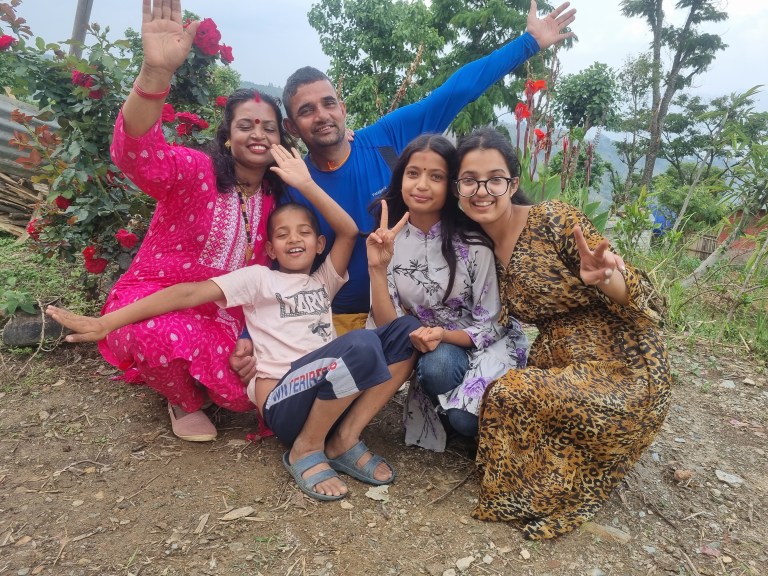
On arrival, I had the traditional Nepalese welcome from Basu’s wife Bimala. A tika (red dot) was placed on my forehead, and a garland of flowers draped around my neck.
Then Bimala asked me if I could do a TikTok with them. So I could see that life here now is a real mixture of the old and new. Over the next couple of days many TikToks were made with me on them. I was dressed in a saree and have become a TikTok star. I am sure all the views are people laughing at me and my funny dancing.
Getting ready for another TikTok
The family included 14 year old girl, Binisha, and 8 year old boy, Aayan. Their eldest daughter, 18 year old Ahupa arrived back from her private boarding school on my second day there. She is studying engineering and like her sister, has really good English. The third daughter is studying science in Kathmandu.
Being a trekking Guide provides a good source of income for a few months of the year but leaves the rest of the family at home to keep the farm going.
My Nepalese familyHindu KarenWomen out working together Family’s goatsHelping Binisha with her English homework
Basu’s house is a 2 story concrete building with 3 bedrooms, a toilet and shower room downstairs and a kitchen and living area upstairs. There is also a large balcony with a covered outdoor fireplace for cooking. Close by is the original mud home that they started married life in and where all their children were born. It now houses the goats and chicken and is used to store corn, etc. They have electricity and running water. We’ll some of the time! When it rains on the early evening, the power goes out, and the internal plumping doesn’t always work. The females were up at 5 am carting water upstairs in the .old pots
Cooking fire on balcinyBedroomMaking flour from riceCutting up meat for curryKitchenGood dal bhat
Over the last 17 years the government has had a rural electrification program which now sees most of Nepal having electricity powered by small Micro Hydropower Plants (MHPs) throughout the country. This has been no mean feat knowing how mountainous and populated this country is. Many villages are high up in the hills, houses are spread out, perched on steep slopes inaccessible by even the toughest 4WD jeeps. Much of the materials and equipment needed had to be carried in by hand or rough roads built first. The supply is not completely reliable especially during rain but is better than nothing.
Basu’s family used the power for lighting, pumping water, and charging the cell phones. They had a gas bottle in the inside kitchen for cooking. I was very well fed, probably too well fed. They would all stand and watch me eat, making sure I liked everything before going out to another room to sit on the floor and eat their food, Nepalese style, with their hands.
I spent 3 days around the village with Basu finding people from my old photos. It was fun to see the looks on their faces as they recognised friend and family from years ago, in a time when they had no access to photographs themselves. They would all crowd around, pointing out people and finding themselves.
That is me!,
Sadly, many of the people had died including Bimala and Puru’s mother. A mother of two toddlers found herself as a 6 year old and remembered looking at my camera in awe back then.
We visited Puru’s father who now lives alone in the same mud house that I stayed in. It definitely was missing a woman’s touch!
Basu and Father looking at album
This time around the kids were much more at ease with me and we gathered a tribe of them as Basu and I walked around the area. Some of the kids had really good English as it is taught in all the schools now.
The school that I visited last time was damaged in the 2015 earthquake so lovely new high school is nearly completed. One of the men working there was in my photos too.
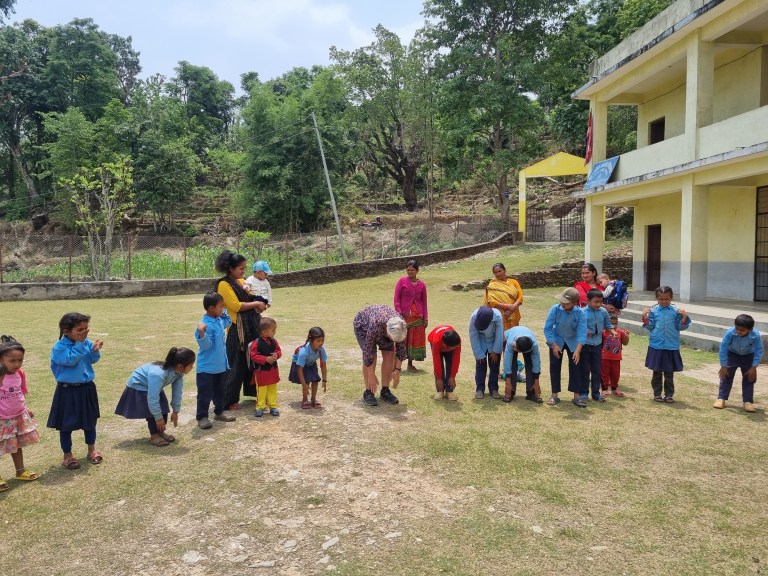
The local primary school, Baljyoti Basic School, has 50 pupils, so I bought 4 exercise / copy books and 2 pencils for each child, at the local Bizzar town on the way here. There was a visiting health nurse and doctor visiting the school, so we took this opportunity to take these to the school the second day I was there.
The very heavy bag of books was carried to the school by Bimala. I suggested that Basu should carry them, being the man, but he replied that their was women’s work. Another thing that hasn’t changed!
Wife carries heavy bag of books
All the mothers were also coming to have a health lesson, which I sat through, understanding very little of what was being said, but getting the main idea.
Parents’ lesson
Washing hands and feeding the family well were the main lessons. Roads and electricity have brought junk food to the villages and, as with the western world, diets have been negatively affected. People are becoming over weight and the resulting diseases are on the rise. Seventeen years ago all the food was grown locally and the people had a good plain organic diet.
I had some fun with the kids teaching them the “Heads, shoulder Knees and toes” game and then I gave out the books and pencils with a lot of ceremony, more tika and flowers from each child. They were all very appreciative of the gift.
Knees and toesAnother big fussBooks for all the kids
On Saturday we walked up to the top of a hill to a temple and the place where family and friends gathered to farewell a person who had died. A new covered area had been built to provide shade and shelter for the mourners. We then wandered through the “cemetery”. Most bodies are burnt in open pits but people with some diseases such as TB are buried.
I was feeling a bit of FOMO, (Fear of Missing Out) as I left the group after pur morning tea break. They were continuing on to walk the Three Passes and up to Everest Base Camp. I had had enough of coughing all night and just needed to get back to a lower altitude to sort it. I wondered how many of the others could keep going given the state if health of some of them, but time will tell.
I walked straight up another Nepalese hill with Dhawa, our second guide. One of our porters was carrying my gear as well as some of young Jo’s gear that he decided he didn’t need, or want to carry. This will be stored in Lukla until they return.
We came across some road makers. They are real craftsmen .
It was a nice climb ending in Lukla. This is the place Ed Hillary and Tenzing Norgate, who were the first people to summit Mt Everest, built an airport. Ed had decided that the walk that I had just completed from Jiri as it was too far for him and his mountaineering mates, so he bought some land from local people and proceeded to make an airport. The story goes that he filled the locals up with alcohol and had them do stomping dances to pack it down.
Arriving in Lukla
I had a day and a half in Lukla, spending it people watching. In the morning, there was a constant stream of trekkers, and their porters heading up to Everest Base Camp or other routes, looking all fresh and clean. In the afternoons, there was a continuous trail of very tired, sunburned people returning.
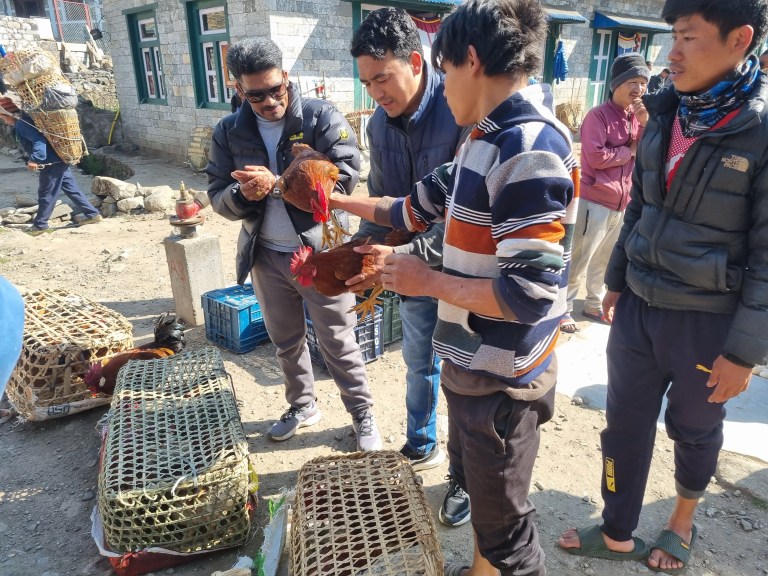
I visited an early morning market. I didn’t buy and chickens or meat.
MarketsPorter carrying a large wheely bag
Some have trekked, but others are here to climb peaks. These usually gave a lot more equipment including ropes and tents etc. These porters usually only carry about 30-40kg but “freight porters” can carry up to 100kg. These ones carry all kinds of things needed up here, like building materials, food and beer. Most of this stuff arrives in Lukla by plane, helicopter or donkey, but then goes up higher by porter.
Trekkers porter
I chatted with a few trekkers whose stories made me a bit sad that I had not carried on. I visited the hospital and started taking cough medicine, which was beginning to reduce my coughing.
I had been awake most of the night again coughing. I tried to make a comfortable sitting position as I coughed like a dying sheep when I lay down. I am very pleased that Kathy just falls asleep and snores all night without being disturbed by me. She doesn’t even wear earplugs.
Kathy and I always get a room to share, usually with an ensuite. This sounds fancy but can be a squat toilet with a bucket or hose for washing our bums. We usually have to pay an extra 300 rupees ($3NZD) for a hot shower. Kathy and I have used the toilet hose for a very quick, cold shower. The boys usually get their own rooms with a bathroom down the hall.
Another 2 succumbing to the sickness with it effecting their chests so everyone is coughing and sniffing. We are a sorry bunch! . Jo is better after anti biotics even though he has continued to drink beer! Grant struggled daily and into the evenings , losing his appetite too.
We had two really nice, relatively easy days sidling across some good farmland. A bit of a steep up for lunch, passing a big piece of road construction. The days were fine and perfect for walking.
We came to the end of the road construction and waited, watching the digger before being to be able to pass. There is not much health and safety going on here. Then we were onto a very busy walking track again.
Another stupaHigh mountains in the distanceRoad bridge under constructionNice gardensGoods for sale at tea stopNew house captures attentionMeeting school kids on the trailEveryone has a goat or threeAnother stupaTamarillo treePasta and egg for dinner65 year old porter with his 40 kg loadAnother porterNrw piece of roadThat is a heavy loadThe end of the roadThat is the end of the roadA beer in the sun at the end of the dayDonkey coralThe guys were very excited to see some deerDon’t hang around KathyThe end of the road Donkey train
Now everything has to be transported by donkey. I had been missing the donkeys as I had fond memories of them from my last visit to Nepal. However after walking into Khari Khola I realised I had forgotten the awful smell of donkey poo. The blokes thought I was a bit soft but I didn’t feel so bad when I saw Pemba was wearing a mask and looking as disgusted as me.
I met up with “The Kiwis” at the Hotel Shanker. This hotel was about $50 a night and is one of the top hotels in Kathmandu. Originally a palace it was very flash, even had a swimming pool. There were 2 weddings there over the 2 days and a couple of engagement parties. It’s definitely the place to be seen.
But these kind of things don’t impress me too much. The room I shared with Kathy cost me about $50, compared to the Flying Yak for $15 a night. There was very little difference.
Very poshKathy gate-crashing a weddingBreakfast buffet
We had a couple of days together, getting to know each other. The Kiwis had some shopping to do as all gear was very cheap. There was a stock of toilet paper and hand sanitiser to buy as these things get much more expensive the further up we go. We also needed to get trekking permits so that was another beep, beep taxi ride.
The boys applying for trekking permits
The five men are all good kiwi blokes: hunters, tampers and generally good kiwi blokes. Brendon is also a doctor, but the others have all worked in the farming sector or outdoor work. Kathy, a retired nurse, was originally for England but traveled her way to NZ in the 1970- 1980s when visited Nepal in the hippy days. Grant, Brendon, and Roger are in their 60’s and have all been to Nepal previously. Roy was at high school with me and this is his first visit to Nepal. The baby of the group is Joe (35ish) aka “The Ruahine Hunter” https://youtu.be/O0qxOBSYe-Q
Joe was very excited to be here and reminded me of how I was when I first arrived 17 years ago. Joe was off out to find the night life on his first two nights here while the others were all heading to bed trying to get over the 24 hours of flying. I remembered my first night here last time. I was sharing a room with Evy, a young Israeli guy. We had gone to bed but couldn’t sleep because of the music coming from the bar next door, so we got up and joined the crowd for a few Everest Beers and toddled back to our room later in the night. Now I am one of those going to bed early and falling asleep with my book.
Roy and Joe shoppingA break from the chaosJoe with street sellers – Yes of course he wants a necklace!
Pemba is to be our Guide. Grant has used him on a couple of previous trips and he comes from the region we will visit. We will also have along Dawa as assistant guide as seven is quite a group to look after. Having two experienced guides means there will be someone to take out anyone who needs to leave the main trek at any time. Dawa has been part of some Everest Summit teams. We will also have 3 porters to carry the gear for 6 of us. Strong, young hunter, Joe, plans to carry all his own gear. I don’t think he understands the effects of altitude as cannot be explained and must be experienced. We will see how he goes.
Drive Kathmandu to Jiri
On the 3rd of May we piled into a mini van for the drive to Jiri. It is 184 km but took about 8 hours. This was 5 star luxury compared to the ride from Jomsom to Pokhara. I am glad that I went on one of the worst bus trips in the world early in this trip so from then on all trips will be much better. Always best to compare with the worst case scenario rather than the best. We had nice seats, no flat tyres, air conditioning , the power to pass other vehicles reasonably safely and only one person was vomiting throughout the journey. (The doctor: poor man!)
The pee stops on the side of the road were much better than at the squat toilets at the roadside cafes, despite the rubbish.
Nice van Rubbish everywhere. They do not seem to understand that this stuff will not biodegradeOur accommodation for the night in JiriPemba and Grant meeting our three young porters
We unpacked and had a wander around the town before meeting for dinner. Our three young porters had just arrived from Lukla after finishing their previous job. They took 3 days to walk here and it will take 7 days to do the same journey with us. They will carry 15kg gear each for two of us, and their own gear. A total of up to 40 kgs and they are only little guys. Amazing strength and for only $15 a day each. I must admit that I have brought along more stuff than I would normally if I had to carry it, but still, my bag is the lightest by far.
Walking east across the foothills of the Himalaya, we went up and over the Lamjura Pass (3,550 m) today. These are not the foothills we are used to in New Zealand as we were higher than Mt Taranaki and Tararua and Ruahine ranges that surround my home.
Once started we become totally absorbed with the task at hand, taking one step after the next, ensuring we stayed upright and could breathe.Wwe are quiet as we ascend, usually only Kathy and I doing any talking as even altitude finds it hard to keep some women quiet. I would try to start a conversation but talk soon dried up: there was no oxygen left for it. The men just huff and puff through the ascents, though the Doctor seems to have more words than the others at this stage.
Sometimes the big strong guys who can run all over the hills lower down don’t do as well as the scrawny old lady higher up. No sense being competitive here. We cannot do anything to alter the physiological changes in our bodies.
Young Jo wasn’t complaining about the slow place. He said that if he was at home he would have knocked anyone going this slow off the track. But this is how it has to happen. Pemba is really good at keeping a good pace and he gives us lots of rest breaks, a morning tea stop and a good lunch break. So we all arrive alive, but not necessarily kicking.
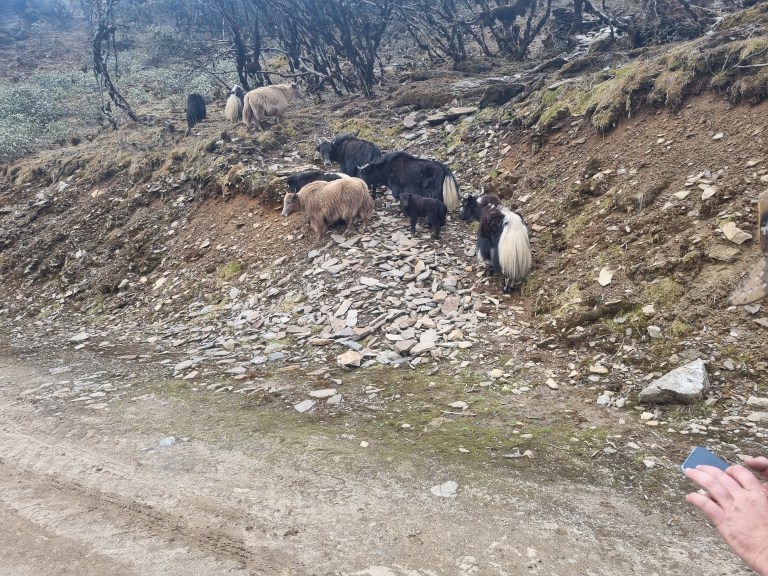
Rhododendrons. National flower of NepalAnother rest stopNew road, lots of rocks Mist coming in, getting higher and colderYaksPemba always helps with the lunchA road in the making A new bridgeJo gives out coloured pencils and school exercise booksA great wall of NepalLocal floraWe arrive at Jambesi after 9 hoursYes I am still aliveCheese and tomatoes sandwich and chips for dinner
We started out knowing we that we had about 50km to walk over 7 days, 7-8 hour days ahead of us to Lukla where I will leave the group. This does not sound much to the average hiker but the high altitude makes a huge difference.
We were to follow in the footsteps of Sir Edmond Hillary and Tenzing Norgate: the first people to summit Mt Everest. Sir Ed decided that this 7 day walk was a bit much to endure before a summit attempt so he eventually built an airport at Lukla. Therefore this trek has had little use by tourists so has remained very much as it has been for centuries. I was to enjoy it much more that the Annapurna Circuit for those reasons.
We would be walking up and down between 2,000 to 3,500 metres above sea level each day. Huge ascents and huge descents as there is no such thing as flat in this area. I have had over two weeks to get acclimatised so faired better than the rest of the crew. Roy had a cold so was feeling a bit rough and Jo was still a bit hung over from his nights on the town. So I was the only one finding the going okay. Pemba was really good and stayed in front walking at the necessary slow pace. I could see that young Joe had probably never walked this slow in his life but was probably glad for the pace.
The first day we walked to Deurali (2,700m) rained most of the day and I started out with my new lilac poncho. Purchased in Kathmandu, I found that it leaked and I was soon getting cold as we walked downhill all the way to a tea stop. At these altitudes going downhill is also a slow pace.
We stopped for a hot cup of tea at a small tea house so I pulled out my new umbrella hat which proved good for the downhill and flat parts of the trail. It reduced my vision too much going uphill. At our lunch break most of the crew bought umbrellas and then, of course, it stopped raining. I think young Jo would have trouble admitting to his hunting mates that he tramped with an umbrella!
Porters packing up their loadsGood luck scarfsWalking in the rainHot tea stopDown, down, downMy new fashion statementUmbrellas everyoneA much needed rest stop
Part way through our first day I got up close and personal with Kathy. She had blood pouring from up under her shorts. The poor porters, guides and the blokes really did not know where to look when they came across Kathy and I on the track. Kathy, had her pants down and I had my head up between her legs, under her long poncho. I was trying to get my bad eyes to focus on the wound so I could work out where the blood was coming from. Kathy had assured me that, at 66 years old, she was not having her period! I couldn’t see too well at that angle but managed to put on a dressing and stem the bleeding. After we arrived that evening I was able to get a better look with my torch and found that it was a leech bite. Naughty little fella getting way up there!
This region is very steep so up and down we went. Sometimes on recently built roads, but mostly on the centuries old tracks. There was very little traffic on the roads as most people had not bought vehicles yet.
We had a nice evening around the pot belly stove and then I coughed all night, getting only about 2 hours sleep. Luckily my room mate, Kathy, snored her way through the night and was not annoyed by me. We are getting on well.
The day started with a huge decent, taking us through a very picturesque valley dotted with houses surrounded by their little farms. Most people here survive on what they grow along with their goats and cows. Then a 1100 metre ascent to Sete. Again, Pemba, went in the front and kept at a really nice steady slow pace.
Rest stopWe came up from the bottom of that valleyWe are heading up to that pass
We made good time arriving at 4.30. Kathy and I washed some clothes. The boys were more interested the teahouse owner, who had some pine trees on his property. He was using his chainsaw, no chaps, no earmuffs, no goggles and wearing jandals. They were very impressed with his final product: perfectly straight boards and all limbs intact.
Relaxing at the end of the dayBoards sawn with chainsawSherpa stew for dinner
We chilled out again at the Flying Yak hotel in the middle of Thamal. This is the backpackers area of Kathmandu although I think I saw more locals speeding around on motorbikes than I saw backpackers.
Originally I was planning to do another 21 day trek going over 5 passes greater than 5,000 metres. Five more of what I had already done!!! Why?
So after much thought , I decided to walk the first 8 days with the Kiwi group, then see how I feel. This will be a nice walk through the lowlands meandering along up and down between 2,000 metres and 4,000 metres of altitude.
I will leave them in Lukla where they can continue onto the higher alttides without me. Unless I change my mind, which I seem to feel free to do at any time, these days.
Kay goes home tomorrow and I will move to the hotel the Kiwis are staying at.
The shops sell treking gear that is knockoffs of all the famous brands. North Face, Kathmandu, Marmot, Leki, Osprey, Salomon, Mountain Hardware etc. . You can buy jackets, sleeping bags, packs, headlamps, cookers, fleece tops, shirts, shorts, all sorts of ski and mountaineering gear. The gear is usually made in the same factories as the stuff we get back at home. However, all the fancy marketing, transportation, and profit structure are missing. Therefore the prices are only about 10% – 20% of what we pay at home. There are hundreds of these little shops and I wonder how they make a living.
Bargain pricesBartering expected Pashmina shawls More shawls Jewelry shops galore (Not my thing at all)Elephants and Christmas decorationsBlingy bags Rugs and bags
I do wonder how any of these shop owners can make a living. There are hundreds of shops selling the same stuff and there is seldom anyone in the shops. Bargaining is the way to go.
We got a bit lost and found the food stalls
This made me pleased that I am going vegetarian on this trip
We paid for a full day tour of some of the UNESCO Heritage sites.
Our guide and driver were good but most of what we saw and heard was religious history. Fantasy stories about the 30,000 different Hindu gods, Buddhas from different countries, one born from the armpits of his mother. About as likely as the Virgin Mary, I suppose.
They are not stories about the real people of Nepal, It seems that the people and their religions can not be separated.
I must say that the reconstruction after the major earthquakes in 2015 has been done amazingly quickly. Christchurch took about 10 years to decide whether to reconstruct the cathedral, while Nepal just seemed to get on with it.
Amazing buildings
Anyway, I have seen my full of temples once again.